Hunting Ducks of the Venice Lagoon
Across the River and into the TreesThe lagoon duck hunt is an episode in which sport becomes a test of discipline: Richard Cantwell reacts to a boatman’s breach of shooting etiquette with anger, then acknowledges his own response and chooses to preserve a wounded duck. The outing unfolds in a landscape where frozen water, managed hunting practices, and the traces of earlier fighting meet, giving the hunt a significance beyond its tally of birds.
Setting and preparation
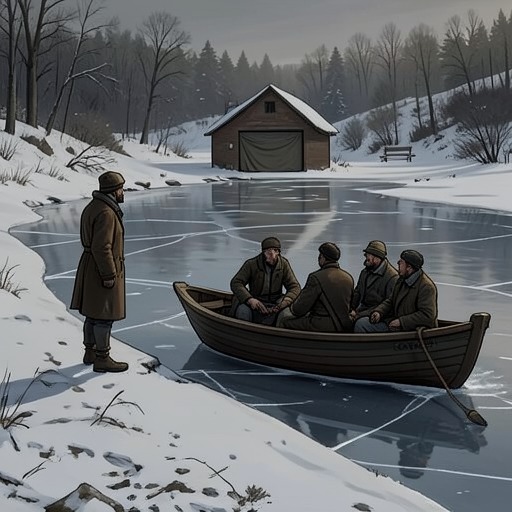
The hunt takes place in the Veneto, where a blind can be made from a sunken oak hogshead. Cantwell describes the blind by its practical purpose: it conceals the shooter from the ducks. The equipment and setting make the outing an organized practice rather than an improvised excursion; later, wooden decoys and a calling hen are retrieved, and a boat is used to move through the ice and collect the birds.
The outing has begun well before Cantwell settles into the blind. He recalls meeting the other men in a garage, sharing a meal cooked over an open hearth, and riding with three shooters in the rear seat on the way to the shooting place. The company’s conversation is shaped by exaggeration and lying: even those who do not lie permit themselves embellishment, while the practiced liars are especially inventive. Cantwell sees this as part of the gathering’s pleasure, though he draws a boundary at false information about coordinates. His ease among the men makes the later breach of etiquette a disruption of an otherwise enjoyable, well-run day.
The lagoon itself is not simply a backdrop. In winter it freezes, and the changing condition of the ice affects the hunt: a calling duck eventually stops looking up, while the boat later has to break ice as it comes in. Earlier, as Cantwell travels toward Venice, he sees the marshes, reeds bent by the north wind, the church tower of Torcello, and Burano’s campanile; sailing barges are moving toward the city. This landscape connects the hunting ground to the wider lagoon and to Cantwell’s sense of Venice as a place he once fought to defend.
The shooting and its breach of etiquette
From his blind, Cantwell watches a pair of pintails descend and shoots first the drake, then its mate as she climbs. Both fall onto the ice. His private response is to recognize the act as killing, even as he continues to find pleasure in the skill of shooting. The juxtaposition holds the episode’s central tension in view: the hunt is at once practiced sport and the taking of living animals.
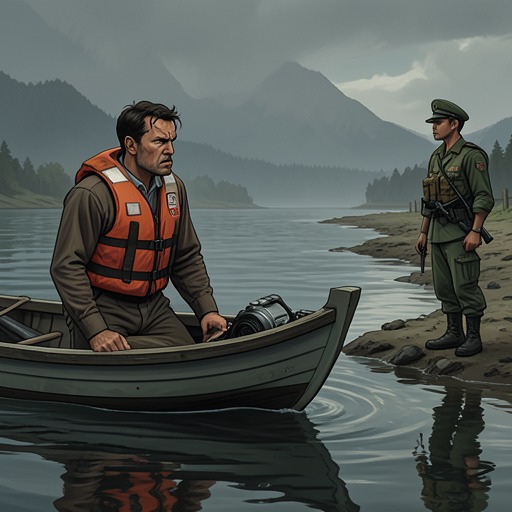
The sharper conflict comes when a group of mallards, which had been coming low toward Cantwell, flare upward. He sees one fall and hears another shot. The shooter is the boatman, whose role is to use a shotgun on crippled birds that might escape where the dog cannot reach them. In Cantwell’s judgment, firing instead at ducks coming toward another shooter’s blind violates the basic obligations of the hunt. The outing had seemed exceptionally well organized, which makes this breach especially difficult for him to accept.
The boatman is too far away to hear a shout. Cantwell therefore fires twice in his direction, knowing the pellets cannot reach him and intending him to understand that Cantwell has noticed what he is doing. The shots do not resolve the dispute; they make Cantwell’s own anger part of it. He recognizes that anger is bad for him, takes two pills, and washes them down with Gordon’s gin from his flask because he has no water. He also knows the gin is bad for him and reflects that rest and very light exercise are the only things he believes are good for his condition. The incident thus tests not only his standards as a shooter but his ability to restrain himself when those standards are violated.
Count, apology, and the wounded mallard
When Cantwell signals for the boatman to come in, he stands in the barrel blind, fires two shots toward the empty sky, and waves him over. The boat arrives slowly, breaking through the ice. The boatman gathers the wooden decoys, catches the calling hen, and puts her in a sack; with the dog moving across the ice, he also collects the ducks. His anger appears to have passed, replaced by satisfaction with the work of gathering the birds.
Asked about the result, Cantwell says he killed four ducks and that the dog found three crippled birds shot by other people. Asked why he fired toward the boatman, he says he is sorry and explains that he shot in anger. This admission does not erase the original breach or his response, but it changes the encounter from an unspoken contest into an acknowledged mistake. His account also distinguishes the birds he killed from the three wounded birds found by the dog, keeping the practical consequences of the day visible alongside its sporting score.
The dog later comes out of the sedge carrying a mallard drake. Cantwell takes the bird himself and finds it intact, though its wing has been grazed. Rather than have it treated as another kill, he says it can be kept as a caller or released in spring, and asks the boatman to put it in the sack with the hen. The decision gives the episode a different ending from the earlier shots: the hunt has not become harmless, but Cantwell chooses to preserve a bird that can still live. The boatman handles it carefully, and Cantwell offers him a drink against the cold.
War, memory, and restraint
The hunt’s landscape carries an older violence. On the road across the Piave River, Cantwell recognizes the sunken road and former positions from the fighting in which he took part as a boy. The canals beside the road once held the bodies of soldiers killed during the offensive. Because the gates farther downstream remained in Austrian hands and were closed, little water moved through the canals; the dead remained there until labor troops hauled them out at night and buried them near the road. Cantwell sees ducks and geese in the canals now, and men fishing there. The same waters that sustained the aftermath of battle have become part of ordinary use and animal life.
The past is also visible in Cantwell’s account of the Piave as a changed river, its water diverted for hydroelectric projects. His recollections place the hunt within a region repeatedly altered by war and by the management of water, without suggesting that the hunt itself is a direct consequence of either. Against that history, the frozen lagoon is both a working environment and a place where human rules govern the taking of wildlife.
At the end of the shooting, Cantwell’s thoughts turn to Renata and their farewell. He tries not to dwell on her absence, recalling that leaving and loving can hurt. The hunt offers company, skill, and pleasure, but it cannot cancel either that separation or his bodily limits. Its final gesture is therefore modest but consequential: after anger has prompted him to fire toward a man, Cantwell apologizes; after shooting a duck, he chooses to keep another alive. The episode makes restraint—not a clean escape from violence—the measure by which he ends the day.